


On Thursday 12th October, Ealing Mencap joined forces with Ealing Public Heath, Cape and others to deliver the second of two Suicide and Self-Harm Prevention workshops, all with the aim of developing a co-produced Suicide Prevention Action Plan in Ealing.
For an easy read copy of this blog post click here.
Across both workshops it was made clear that there is no ‘’typical’’ person that experiences suicide ideation. It affects many different people, from many different backgrounds. The latest figures show that 5,219 suicides were registered in England alone (Samaritans). Since 1990, men have been at least three times as vulnerable to death from suicide as women.
Within Ealing, suicide awareness is a pressing concern. In recent years, the borough has witnessed a growing need for support and understanding when it comes to mental health and suicide prevention. Ealing has the 4th highest suicide rate across all 33 London Boroughs. The population that recorded the highest number of deaths by suicide, in Ealing, were from Polish men.

Suicide Prevention Workshop
Protected Characteristics
Did you know that information identifying the person who has died, such as age, religion/belief, sexual orientation, disability, race, etc, is not always recorded by public services?
Globally, the availability and quality of data on suicide and suicide attempts is poor (WHO), and in the UK there is limited research on the recording of protected characteristics as far as suicide data is concerned. As mentioned, suicide ideation does not discriminate but some groups have shown to have higher rates of suicide or suicide attempts than others and experience more negative social conditions. However, due to the lack of data on protected characteristics, it is more difficult for professionals to draw conclusions and predict trends to support those in need. Looking forward, including protected characteristics in suicide data recording is not only essential for public health initiatives but also holds significant value for honoring the individual who has died and supporting their grieving family.
Self-harm
A reflection from the initial workshop was that engaging in self-harm may be linked to suicide ideation, as both behaviors can be indicative of significant emotional distress and a need for support. Whilst there are many definitions of self-harm, the NHS describes it as; “when somebody intentionally damages or injures their body. It is a way of expressing deep emotional feelings.” Sadly, 1 in 14 people in the UK self-harm (NHS Digital). At the workshop, a contributor with lived experience, bravely gave their harrowing account through the eyes of a parent whose child suffers from mental health challenges, self-harm, and suicide ideation.
Discussing Makaton
We were honoured to be involved in planning the workshop, as it gave us an opportunity to represent the voice of people with learning disabilities on the topic of suicide prevention. Ealing Mencap Independence Development Worker (IDW) Abdurraheem Ahmed, delivered a mini workshop on useful makaton signs. The workshop focused on understanding emotions and ways to offer help to someone with communication needs who may be in a crisis.
To find out more about makaton head to our Makaton Flashmob Blog.
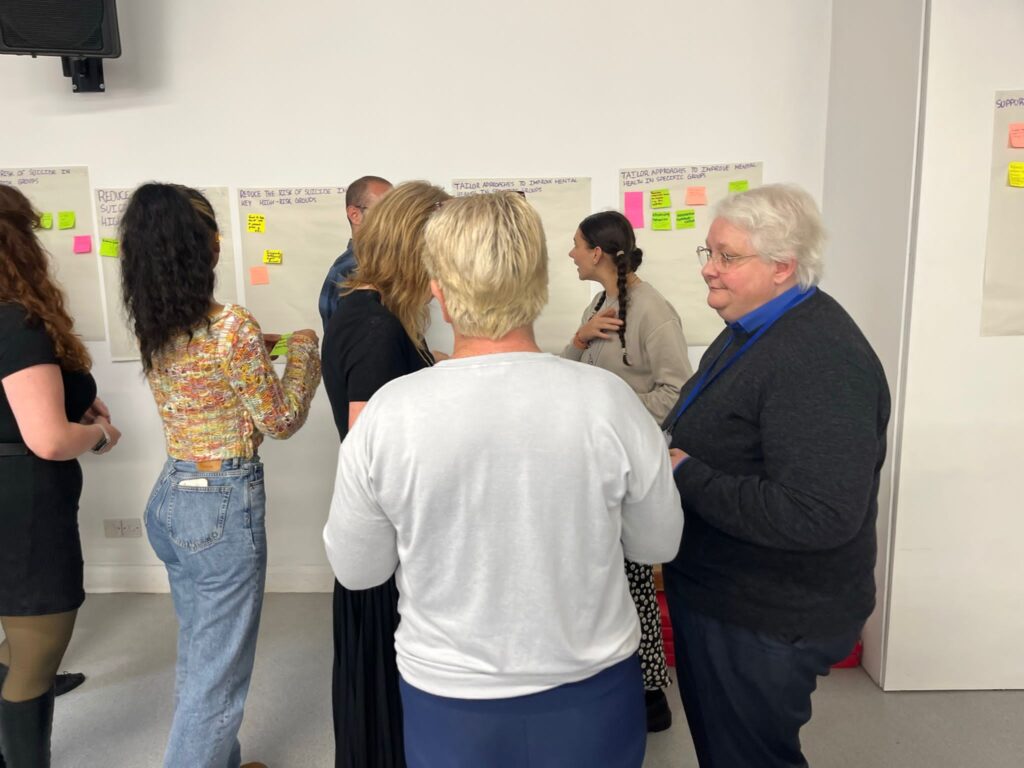
Suicide Prevention Workshop
The Need For Communication
Individuals with learning disabilities often face multiple challenges in their lives, including communication barriers. These barriers can be isolating and hinder their ability to seek help or express their emotions. Sadly, the impact of these communication barriers can extend to serious consequences. People with learning disabilities sometimes experience suicidal thoughts and, in tragic cases, die by suicide. Disability rights UK has gathered National data which shows that there is a disproportionately high suicide rate amongst disabled people. According to the latest data released from the 2021 Census, disabled people are much more likely to die by suicide than non-disabled people.
For men, the figure for disabled men was over three times higher – 48.36 deaths by suicide per 100,000 people compared to 15.88 deaths by suicide per 100,000 people for non-disabled men.
For women, the figure for disabled women was over four times higher – 18.94 deaths by suicide per 100,000 people compared to 4.47 deaths by suicide per 100,000 people for non-disabled women.
We must begin to address the communication barriers for individuals with learning disabilities and provide essential support and resources in order to reduce the risks associated with suicide ideation. By breaking down these barriers and fostering open, accessible communication, we can contribute to improving the well-being of individuals with learning disabilities.
Communication is a recognised barrier to supporting the mental health of people with learning disabilities. However, as mentioned, due to the lack of significant data collection after a suicide, it is harder to assess how to best support the prevention of suicide for people with learning disabilities. It must be recognised that without the accurate recording of protected characteristics of suicides, there will continue to be barriers to overcome.
For supporting people with learning disabilities with suicide prevention, here are some helpful resources.
Makaton Video
Stay safe tool kit for people with learning disabilities
Words from Raj (Senior Public Health Specialist)
We spoke to Raj Hira, who co-hosted the workshop, here is what she said:
“I had the privilege of Co-hosting and delivering our second workshop to develop a co-produced suicide prevention action plan for Ealing in collaboration with our amazing partners and lived experiences voices.
Creating a safe space where everyone can express themselves freely isn’t easy, the credit for this goes to the members of the suicide prevention collaborative that developed and designed the workshop.The passion, energy, enthusiasm shown by everyone to a subject that is complex and sensitive. We are determined to change things locally and will strive to make this happen. These type of events are not successful without the support of delegates and those attending. The input from those attending the workshop will form our plan locally and priorities for suicide prevention, I feel so proud and humbled to be part of such an amazing initiative.
Thank you everyone that has been involved and I look forwards to updating in the coming months!”
This post contains some difficult topics. If you are struggling with suicidal thoughts and need to speak to someone, here are some emergency contacts:
Samaritans – for everyone
Call: 116 123
Email: jo@samaritans.org
Campaign Against Living Miserably (CALM)
Call: 0800 58 58 58 – 5pm to midnight every day
Visit the webchat page
Papyrus – prevention of young suicide HOPELINE247
Call: 0800 068 41 41
Text: 07860 039967
Email pat@papyrus-uk.org
Childline – for children and young people under 19
Call: 0800 1111 – the number will not show up on your phone bill
SOS Silence of Suicide
Freephone helpline: 0808 115 1505 (Open Mon-Fri, 8pm until midnight, Sat & Sun, 4pm until midnight)
Email: Contact@silenceofsuicidesos.org.uk
